Skip to product information
1 of 14

The FlatTop Micro Induction Sterilizer

Regular price $149.99 USD
Regular price $174.99 USD Sale price $149.99 USD
Sale Sold out
Shipping calculated at checkout.

Low stock: 5 left

Color: White
Quantity

Your flame is slowing you down. You just don't notice it anymore.

Every sterilization cycle with an alcohol lamp follows the same pattern: stop what you're doing, pick up your scalpel, hold it in the flame, wait for the tip to glow, set it somewhere clean, wait for it to cool, pick it up again. Then make your transfer. Repeat for every plate in a 20-, 30-, 50-plate session.

It works. But every one of those cycles is friction — and that friction adds up.

There's also the part nobody talks about in polite mycology circles: open flame inside a still air box is a real fire hazard. Isopropyl alcohol has a flash point of 12°C (53°F). That's below room temperature. One slip with a hot blade near an IPA-soaked paper towel and your SAB becomes a problem. And if you've invested in a flow hood, your alcohol lamp is actively disrupting the laminar airflow you paid for — a rising heat column punches through the horizontal curtain your HEPA filter worked to create.

The FlatTop removes all of it.


How the FlatTop Works — and Why Each Part Matters

Proximity Sensor Activation — No Touch Required

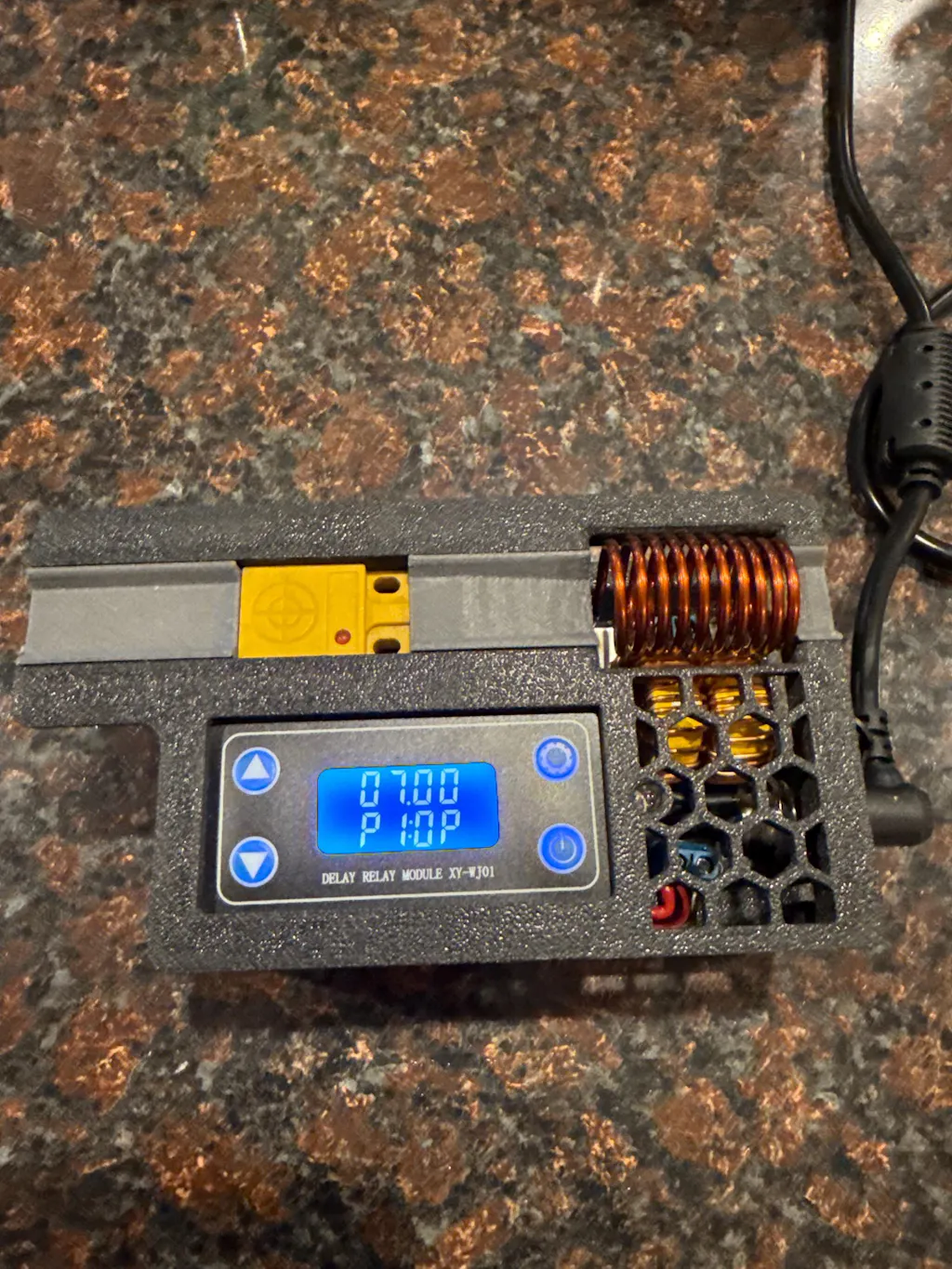
An inductive proximity sensor detects ferrous metal within approximately 5mm. When you place your scalpel in the tool slot, the cycle starts automatically. When the cycle ends, it stops. No button press. No foot pedal. No hand wave. The unit only activates when an instrument the induction coil can actually heat is present — which means no accidental triggers from non-ferrous tools or your hand passing nearby.

Why this matters: Every other induction sterilizer on the market requires you to press something. A button, a switch, a foot pedal. That means stopping your work, consciously triggering a cycle, and managing one more action in an already demanding workflow. The FlatTop removes that action entirely. You place the tool. The tool gets sterilized. You do something else.

Pre-Set 7.5-Second Cycle — User Adjustable

The FlatTop ships pre-programmed to 7.5 seconds — the optimal cycle time for a standard #11 blade on a #3 handle. That's the most common scalpel configuration in mycology. Plug it in and you're working immediately. If you use heavier instruments, you can reprogram the solid-state time-delay relay to match your tools. The relay supports a programmable range of 0.1 to 999.9 seconds.

Why this matters: Scalpel sterilization needs 5–8 seconds. A cycle that runs 20–30 seconds isn't more sterile — it's just slower. The FlatTop is tuned for the actual work, not designed around a fixed default that ignores your instrument size.

Open Design — Wide Tool Compatibility, Fast Cleanup

The FlatTop's open slot accepts a wider range of tool geometries than enclosed models. Standard scalpels, heavier handles, and syringes with ferrous metal needles all work. The open design also means a single wipe with 70% IPA and the unit is clean — no enclosure to work around, no insert to remove.

Why this matters: Labs that work with multiple instrument types — scalpels, inoculation loops, syringe needles — need a sterilizer that doesn't limit their toolkit. The open design is also the fastest to disinfect between sessions or at the end of a run.

Built-In Tool Parking

Between transfers, your scalpel stays in the FlatTop. There's no separate tool rest, no sterile surface to find, no worrying about where to set a hot blade. The FlatTop holds it. Both hands are free for parafilm, labeling, plate handling, or anything else the workflow demands. When you reach for the tool again, it's already been re-sterilized.

Why this matters: The tool parking problem is underappreciated. During a 30-plate agar session, you set your scalpel down and pick it up dozens of times. A dedicated, sterile resting place that doubles as your sterilizer removes the "where do I put this" decision from every cycle.

No Flame — SAB Safe, Flow Hood Compatible

Induction heating works through electromagnetic induction, not combustion. Only the ferrous metal tool heats up — the coil housing and surrounding air do not. No convection plume. No fire risk. No IPA hazard. The FlatTop is safe to use inside a still air box and produces zero airflow disruption alongside a laminar flow hood.

Why this matters: If you work in a flow hood, open flame is incompatible with proper technique — convection from an alcohol lamp creates turbulence that defeats the purpose of HEPA filtration. If you work in a SAB, open flame in an enclosed plastic box with IPA-soaked surfaces is a meaningful risk. The FlatTop works cleanly in both environments.

Engineering-Grade Materials, Modular Construction

The FlatTop's frame and housing are 3D printed using ABS-GF (glass fiber reinforced ABS) and PA6-CF (carbon fiber reinforced nylon) — engineering-grade filaments selected for heat resistance, dimensional stability, and durability. Assembly uses stainless steel fasteners and copper heat inserts. The unit is modular: all major components are replaceable with a screwdriver and hex key.

Why this matters: This is a tool that lives on your bench and gets handled in every session. The materials are chosen to withstand heat exposure and repeated use. Modular construction means if anything ever needs service, it's repairable — not disposable.

Who Is the FlatTop For?

Growers doing regular agar work

If you're doing agar-to-agar transfers, cloning, or isolation work on any kind of consistent schedule, the FlatTop pays for itself in workflow quality immediately. The more plates you run per session, the more obvious the improvement over flame-based methods.

Flow hood owners

You spent $900–$2,100 on a laminar flow hood to maintain clean, unidirectional airflow. An alcohol lamp inside that environment creates convection that works against everything your hood is doing. The FlatTop is the right tool for a flow hood environment — no heat column, no disruption.

Still air box users who want to eliminate fire risk

Working with open flame in an enclosed plastic box alongside IPA-soaked surfaces is a risk combination that doesn't need to exist. The FlatTop works safely inside a SAB without fire hazard or oxygen consumption.

Growers who want both hands on their work

Agar work involves constant switching between cutting, transferring, labeling, sealing, and parafilming. Every one of those steps needs two free hands. The FlatTop gives you both hands back by removing the hold-and-wait step from every sterilization cycle.

Growers who also work with liquid cultures and syringe needles

The FlatTop's open design accepts syringes with ferrous metal needles — a common need for LC work that enclosed models can't accommodate without removing inserts.


What Makes the FlatTop Different

It's the only open-design induction sterilizer with proximity sensor automation. Most induction sterilizers — at every price point — require a button press or foot pedal to start a cycle. The FlatTop's proximity sensor detects when your tool is inserted and runs the cycle automatically. That's a fundamentally different workflow, not a different housing on the same mechanism.

The timing is programmable and precise. Some automated units run fixed cycles of 20–30 seconds — far longer than scalpel sterilization requires. The FlatTop ships pre-programmed to 7.5 seconds and lets you dial in exactly the cycle time your instruments need. No wasted time, no guesswork.

The open design accepts the widest range of tools. Enclosed models limit what fits inside. The FlatTop's open slot handles standard scalpels, heavier handles, and syringe needles — and is the fastest to wipe down between sessions.

It's priced to be accessible without being cheap. Professional infrared sterilizers designed for clinical lab use cost $450–$600 and weren't built for mycology. The FlatTop is purpose-built for this application at a price point that makes sense for serious hobbyists and small commercial operations alike.

One year warranty. Engineering-grade build. Made in Montana. Not assembled overseas and drop-shipped. Built by hand in Whitefish, Montana, with materials selected for the thermal environment it works in.


If you are comparing autoclave, UV, alcohol, flame, bead, infrared, or induction sterilizers for mycology, the difference is workflow. These are built for the between plates moment.

Compared to common alternatives

Autoclave and UV are effective, but they are not practical for continuous reuse of the same tool during a session. Autoclaves run in batches and take time. UV needs dwell time and line of sight and it does not solve tool parking between plates.

Alcohol wipes or dips help with general sanitation, but they are not a fast repeat cycle sterilization method. Alcohol needs adequate contact time and the tool must fully dry before use. Wet alcohol introduces extra handling and can disrupt sterile technique between plates.

Traditional induction often requires a button or foot pedal and you still need a place to set the tool down between uses. Torches have the same workflow issue and add extra motion and residue risk. Bead and infrared units often require warm up or preheat and add maintenance or always hot wear.

Why fully automated matters

Sterile work involves frequent sterilization and frequent moments where you need both hands. With a fully automated cycle, you place the tool in or on the unit and continue working. The tool stays parked safely between uses and is ready when you reach for it again.

View full details
  • Black and white drawing of an automatic induction sterilizer with product dimensions

    Chamber Diameter: 0.55 in / 14mm

    Chamber Length: 5.5 in / 140mm

    External Dims. (in): 5.67 x 2.5 x 3.2
    External Dims. (cm): 14.4 x 5.2 x 80

    Weight: .55 lbs (250g) w/o power supply
    Electrical: Input: 100-240V 50-60Hz; Output: 12v 10A

Inductive proximity sensor — ferrous metal detection, ~5mm range
7.5 seconds (pre-programmed, user adjustable)
5–10 seconds depending on tool mass
0.1 – 999.9 seconds
800°C+ at metal tip
Ferrous metal instruments (carbon steel scalpels, inoculation loops, ferrous syringe needles)
0.55 in / 14mm
5.5 in / 140mm
5.67 × 2.5 × 3.2 inches (14.4 × 5.2 × 8.0 cm)
0.55 lbs / 250g (without power supply)
12V DC, 10A (included power supply)
100–240V, 50–60Hz (universal — works worldwide)
ABS-GF and PA6-CF (engineering-grade 3D printed), stainless steel fasteners, brass heat inserts
Solid-state, MOSFET-based time-delay relay
Open slot — wide tool compatibility, fastest wipe-down
1 year limited. Repair, replace, or ship components — your choice.
Designed and build by hand in Whitefish, Montana
FlatTop unit + 12V 10A power supply. Pre-programmed. Ready to use immediately.

Frequently Asked Questions

An induction sterilizer uses an electromagnetic field to heat the metal portion of your tool to sterilizing temperatures in a controlled way. You get consistent, repeatable sterilization without open flame, soot, or burning alcohol. This keeps your workflow cleaner and safer around alcohol wipes, 70 percent spray, and filtered air. It also frees up your hands so you can focus on sterile technique instead of fighting with a torch.
You insert the metal portion of your tool into the heating zone and the induction coil rapidly heats only that metal. The tip reaches red-hot sterilizing temperatures within a set cycle, then begins to cool while staying in the housing. You remove the tool once it has cooled to a usable temperature and go straight back to work. The electronics manage power and timing for you so you get the same result every cycle.
The unit works best with magnetic stainless steel tools such as scalpels, forceps, tweezers, and inoculation tools designed for mycology. Non-metal or low-metal tools will not heat properly because induction relies on the metal itself to generate heat. Avoid plastic handles or parts inside the heating zone unless they are rated for high temperatures. Always check your specific model’s compatibility notes before using a new tool.
Yes. You remove open flame from the equation, which lowers the risk when you work around isopropyl alcohol, paper towels, and plastic bags. The heating element is enclosed, and the tool only heats when it is in position and the cycle is running. That reduces accidental burns, flare-ups, and hot tools rolling around your workspace. It is still a high-temperature device, so you should follow the safety guidelines and let tools cool before use.
Set the unit on a stable, ventilated surface, plug it into the correct power source, and follow the startup steps in the manual. Run a test cycle with a tool so you understand how hot it gets and how long it takes to cool to a working temperature in your environment. Keep the tool housing free of debris and wipe the exterior down regularly to prevent dust and spore buildup. Do not spray liquid directly into the housing and avoid blocking any vents so the electronics can stay cool and reliable over long sessions.
Rhizo Funga micro sterilizers are designed for laboratory, hobby, mycology and plant tissue work. They are not intended for medical, surgical, or clinical applications. Use only for heating and sterilizing tools related to mushroom cultivation or related plant lab work.