Induction Sterilizer Guide

Fully Automated Induction Sterilizers for Mycology

Induction sterilizers heat your scalpel blade using electromagnetic induction — no flame, no alcohol, no combustion. Place your tool in or on the unit and a proximity sensor triggers the sterilization cycle automatically. No button to press. No foot pedal. The cycle completes in 7.5 seconds and the blade is ready for transfer.

Rhizo Funga makes two induction sterilizers for mycology: the LabRat (enclosed housing, ergonomic 22.5° slot) and the FlatTop (open-top, wide tool compatibility). Both use the same proximity sensor automation and 7.5-second default cycle. Both are made in Montana.

Why Induction vs. Flame

Flame sterilization — alcohol lamp, butane torch, or propane — works, but it introduces combustion byproducts onto your blade at every cycle. Carbon particles and unburned hydrocarbons deposit on the blade surface and transfer directly to your agar medium. This creates visible soot marks on plates, masks early contamination, and introduces a chemical variable you can't account for in sensitive cultures.

Induction heating involves no combustion. The electromagnetic field heats only the ferrous metal of the tool. Nothing burns. Nothing deposits. The blade is chemically identical before and after the cycle — except sterile. In a laminar flow hood, induction sterilizers also eliminate the heat convection problem: no open flame means no disruption to your HEPA-filtered laminar airflow.

Which Is Right for You?

LabRat vs. FlatTop

Both sterilizers use the same core technology — proximity sensor automation, 7.5-second cycle, no flame, no buttons. The difference is housing design and tool compatibility.
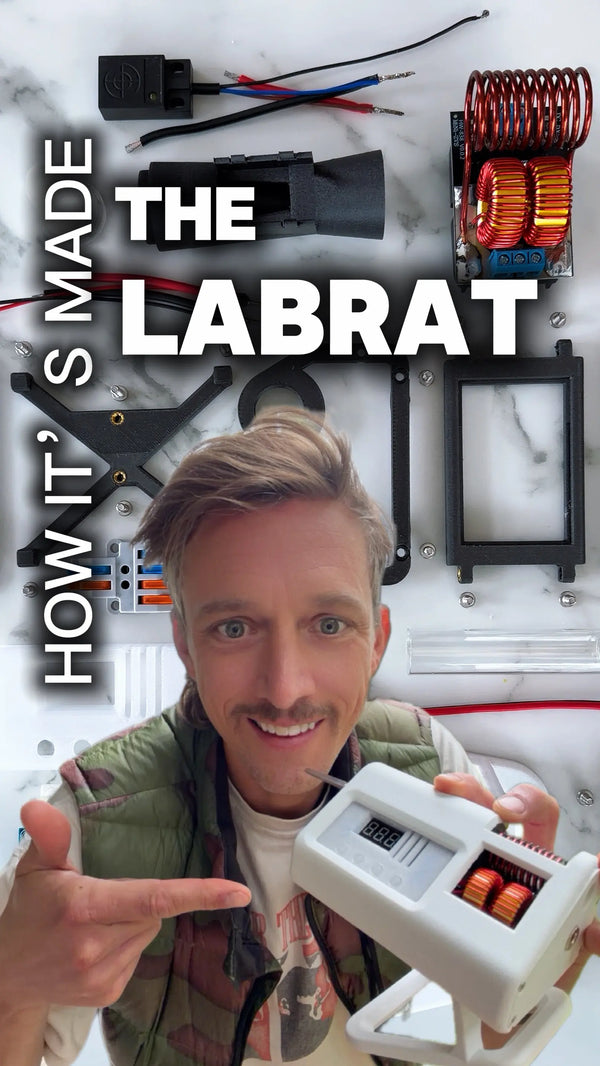
Micro sterilizer with 'RF' and 'The Micro Sterilizer Story' text on a gray background
Induction sterilizer with text 'The Best Induction Sterilizer' and brand logo.
Person wearing blue gloves transferring a culture onto green agar, text overlay questioning sterile workflow.
3D printed form-fitting packaging on a printer with text 'Order in. Order out' and '3D Printed Form-Fitting Packaging'.
  • Scalpel being inserted into a Black Automatic Induction Sterilizer

    No button or foot pedal

    Place the instrument in or on the unit and the cycle runs automatically. You stay focused on sterile work instead of triggering a cycle every time.

  • Two hands sealing a colonized agar dish with parafilm

    Hands free between uses

    During agar work you constantly switch between cutting, transferring, labeling, and sealing. The sterilizer becomes the safe parking place for the tool until you need it again.

  • Black Automatic Sterilizer being reprogrammed to run a longer sterilization cycle.

    Timed cycle you can tune

    Ships pre programmed for 7.5 seconds, which is ideal for a common scalpel setup like a #11 blade on a #3 handle. Timing is user adjustable to match tool mass and preference.

mycology lab bench with scalpel, agar plate, flow hood and induction sterilizer

Why automation is a game changer in mycology lab work

A typical working session involves frequent sterilization and frequent moments where you need both hands. Example. You use your blade to cut and transfer an agar wedge. Next you parafilm and label the plate, which takes both hands. With fully automated induction, you place the tool back into the sterilizer and continue working. When you reach for the tool again, it is ready without you holding a trigger, waiting on a preheat, or searching for a place to set it down.

Learn More
White electronic device with a red light and digital display on a black background

The LabRat. Enclosed and ergonomic

The LabRat ($174.99) uses an enclosed housing with a 22.5-degree angled insertion slot. The enclosed design protects the coil cavity from debris and provides a cleaner working environment for flow hood use. The ergonomic angle matches natural scalpel hand position during agar transfers. Best for: dedicated agar work, flow hood use, scalpel-based workflows.

Buy
Black induction sterilizer with digital display, copper coil, proximity sensor, and tool tray on a white background

The FlatTop. Accepts a wide verity of Tools

The FlatTop ($149.99) uses an open-top design with a wide slot that accommodates a broader range of tool types and handle sizes — loop inoculators, non-standard scalpels, and tools that won't fit the LabRat's enclosed cavity. Best for: mixed tool use, open benchtop work, growers who use multiple instrument types.

Buy
Default timing and adjustability

Ships pre programmed to run a 7.5 second cycle. Users can reprogram the time delay relay using the built in buttons to match tool mass and preference. The relay supports multiple behaviors. For this application only program 1.1, 1.2, and 1.3 apply. Units ship set to program 1.2.

Trigger and metal compatibility

The trigger uses an inductive proximity sensor that detects ferrous metals within about 5 mm. This is intentional. It ensures the unit only triggers on instruments the induction coil can actually heat.

Built to last and modular

Designed and manufactured by hand in Whitefish, Montana. Frames and housings are 3D printed using engineering filaments including ABS GF and PA6 CF. Assembly uses stainless steel fasteners and copper heat inserts. Both models are modular with replaceable components using a screwdriver and hex key. Timing control is solid state and MOSFET based.

  • Autoclave & UV Sterilizers

    Both are effective. They are not practical for continuous reuse of the same instrument during a working session. Autoclaves run in batches and take time. UV needs dwell time and line of sight and it does not solve the between plates workflow or tool parking between uses.

  • 70% Isopropyl Alcohol

    Alcohol helps with general sanitation but it is not a fast repeat cycle sterilization method for frequent tool reuse. Alcohol needs adequate contact time to be effective and the tool must fully dry before use. Wet alcohol adds handling steps and can disrupt sterile technique between plates.

  • Torch & Flame

    Works, but you still need a place to set a hot tool down between uses. It also adds extra motion and can leave residue on tools.

  • Manual Button & Pedal operated Induction Sterilizers

    Often requires you to hold the instrument and actively hold a button or foot pedal for the duration of the sterilization cycle. You still need to set the tool down to free your hands.

  • Glass Bead Sterilizers

    They can store tools, but require warm up and more routine cleaning. That adds maintenance and workflow friction.

  • Infrared Sterilizers

    Effective, but typically require preheat and often do not store your tool between uses. Many run hot continuously, which can reduce lifespan over time. Infrared and bead options can also work on non ferrous materials like glass. Most mycology tools used for agar work are ferrous metal instruments.

Use and cleaning best practices

  • Use in front of a flow hood for best sterile workflow
  • To avoid inadvertently triggering a sterilization cycle when removing your instrument, lift the before you pull out. If a cycle is inadvertently triggered, just let the cycle run. It will not harm the sterilizer.
  • Limit Sterilization cycle time to only the time required to effectively sterilize your instrument, about 5-10 seconds depending on its size
  • Unplug when not in use
  • When your work is finished, you can store your instrument in the device. When you return, gently lift and set your instrument back down to resterilize the instrument before use
  • Unplug before cleaning
  • Wipe exterior with a cloth lightly dampened with 70 percent isopropyl alcohol
  • Do not spray liquid directly onto the unit
  • Ensure the unit is fully dry before plugging in and using again

Frequently Asked Questions

The sterilizer detects insertion of your metal instrument, runs a timed heating cycle, then turns off automatically. You set the tool down and it sterilizes while you work.
An induction sterilizer uses an electromagnetic field to heat the metal portion of your tool to sterilizing temperatures in a controlled way. You get consistent, repeatable sterilization without open flame, soot, or burning alcohol. This keeps your workflow cleaner and safer around alcohol wipes, 70 percent spray, and filtered air. It also frees up your hands so you can focus on sterile technique instead of fighting with a torch.
Set the unit on a stable, ventilated surface, plug it into the correct power source, and follow the startup steps in the manual. Run a test cycle with a tool so you understand how hot it gets and how long it takes to cool to a working temperature in your environment. Keep the tool housing free of debris and wipe the exterior down regularly to prevent dust and spore buildup. Do not spray liquid directly into the housing and avoid blocking any vents so the electronics can stay cool and reliable over long sessions.
Yes. You remove open flame from the equation, which lowers the risk when you work around isopropyl alcohol, paper towels, and plastic bags. The heating element is enclosed, and the tool only heats when it is in position and the cycle is running. That reduces accidental burns, flare-ups, and hot tools rolling around your workspace. It is still a high-temperature device, so you should follow the safety guidelines and let tools cool before use.
Yes. Place your instrument in the LabRat or on the FlatTop and the unit runs a timed sterilization cycle automatically. No button or foot pedal required.
Yes. We are more than happy to help you on your journey. Whether its questions about products or mushroom cultivation and mycology, feel free to contact us at Support@rhizofunga.com. We have an entire archive of proven recipes and TEKS that we are happy to share with the community. We can help with agar plates, sterilizing grain, making grain spawn, liquid culture, substrate, sterile technique, home and commercial lab and farm setups. You name it we have your back.
Each unit ships pre programmed to run for 7.5 seconds, which is ideal for a common scalpel setup like a #11 blade on a #3 handle.
Yes. Users can reprogram and save the cycle time using the built in buttons.
The trigger uses an inductive proximity sensor that detects ferrous metals within about 5 mm. This intentionally limits activation to instruments the induction coil can heat.
They share the same core components and function the same.The LabRat is enclosed with a 22.5 degree angled face and insert for ergonomics and reduced exposure while the tool rests. The FlatTop is open and easier to wipe down. FlatTop is also a lower price option.
Unplug first. Wipe exterior with a cloth lightly dampened with 70 percent isopropyl alcohol. Do not spray liquid directly onto the unit. Ensure it is fully dry before plugging in and using again.
Yes. It is designed to fit a standard sterile workflow in front of a flow hood, but can also be used in a still air box, if that is what you use.
You insert the metal portion of your tool into the heating zone and the induction coil rapidly heats only that metal. The tip reaches red-hot sterilizing temperatures within a set cycle, then begins to cool while staying in the housing. You remove the tool once it has cooled to a usable temperature and go straight back to work. The electronics manage power and timing for you so you get the same result every cycle.
An induction sterilizer generates a high-frequency electromagnetic field inside its coil. When a ferrous (iron-containing) metal tool tip is placed inside the field, eddy currents form within the metal and generate heat directly inside the blade. The coil and housing do not heat up — only the metal tool tip does. The proximity sensor detects when your tool is in position and triggers the cycle automatically.
Any tool with a ferrous metal tip — standard mycology scalpels, dissection scalpels, inoculation loops (steel), and most metal lab implements. Non-ferrous metals (aluminum, titanium, brass) will not heat in an induction field. If your scalpel is attracted to a magnet, it will work in an induction sterilizer.
Both the LabRat and FlatTop ship pre-programmed to a 7.5-second default cycle. Cycle time is user-adjustable. Most mycology scalpels reach sterilization temperature well within the 7.5-second window.
Yes. Both units operate on standard household current, produce no open flame, no combustion byproducts, and no heat convection. They are designed specifically for flow hood and still air box use. Allow the blade to cool before touching agar — the same precaution as any sterilization method.
No. Both units are fully hands-free. The proximity sensor detects tool insertion and triggers the cycle automatically. This is a key difference from competitor units that require a button press, PIR motion sensor wave, or foot pedal to initiate the cycle.
Rhizo Funga uses an inductive proximity sensor for automatic triggering — the most precise and reliable automation method available. Competitors like ThermoHelix use passive infrared (PIR) motion sensors, which can trigger from incidental movement and require a specific wave motion to activate. Others require a button press or foot pedal. Rhizo Funga units trigger only when your tool is physically inside the sterilization zone, every time, without any deliberate gesture or button press.

Warranty and real world track record


One year warranty. Replace, repair, or ship parts based on your preference. Over 75 units sold across Shopify, Etsy, eBay, and TikTok Shop. Shopify uses Judge.me reviews and syncs Etsy reviews. All reviews to date are 5 star. Zero warranty claims so far.